Evidence Status
- Token name: KlimaDAO (KLIMA)
- Network: Polygon (MATIC)
- Contract: verify current contract address at klimadao.finance or CoinMarketCap — do not use addresses from third-party articles
- Current price: KLIMA trades at approximately $0.038 as of the time of review, compared to an all-time high of $3,946 — a decline of over 99% from its peak
- Circulating supply: approximately 7,997,365 KLIMA in circulation as of September 2025
- Treasury: KlimaDAO has allocated $1.6 million to funding new carbon projects and holds over 18 million tokenized carbon credits in its treasury
- Team identity: publicly identified core team — verify current team at klimadao.finance
- Legal entity: DAO structure — no single incorporated legal entity; governance through token voting
- Audit status: verify current smart contract audit at klimadao.finance/audits
- Carbon credit backing: KLIMA is backed by BCT (Base Carbon Tonne) tokens in the treasury — verify current BCT backing ratio at klimadao.finance
- Governance: on-chain governance through KLIMA token voting — proposals and votes publicly verifiable at snapshot.org
Current Status
KlimaDAO’s current price is $0.03792 with a 24-hour trading volume of $81.92 — indicating very low trading activity relative to a project that once traded above $3,000. The protocol remains operationally active with ongoing treasury management and carbon credit accumulation, but trading liquidity is significantly reduced from its 2021-2022 peak.
Klima DAO is not a scam in the sense of an anonymous operation designed to steal deposited funds. It is a publicly identified DeFi protocol with documented governance, verifiable on-chain treasury, and a published mission. The risk factors are different from those of the fake trading platforms reviewed elsewhere on ScammerWatch — they relate to market risk, protocol sustainability, and carbon credit quality rather than misappropriation of funds.
Open Questions
- Is the BCT backing ratio sufficient? Each KLIMA token is backed by at least one tonne of tokenized carbon credits — verify the current backing ratio at klimadao.finance/infinity. If the market price falls below backing value, the protocol enters a theoretically supported floor, but actual liquidity to exit at that price is a separate question
- What is the current quality of carbon credits in the treasury? The original article documents concerns from Gold Standard about the quality of blockchain-based carbon offsets — verify the current composition of the Klima treasury and the vintage and quality of held BCT
- Is the staking mechanism still active? The original high APY staking that drove the 2021-2022 price surge has moderated significantly — verify current staking rates and mechanisms at klimadao.finance/stake
- What is the current governance participation rate? A DAO with low governance participation may not effectively represent token holder interests — verify recent proposal activity at snapshot.org for KlimaDAO
- Has the protocol been independently audited since launch? Verify current audit coverage and any findings at klimadao.finance/docs

Is Klima Crypto Legit?
The question in the heading above is a rather complicated one. Klima DAO is a legitimate project in the sense that it is not a scam.
Klima DAO is a publicly identified DeFi protocol — not an anonymous operation. The team is publicly documented, governance is on-chain, and treasury holdings are verifiable. The verification questions relevant to Klima DAO differ from those applied to anonymous fake trading platforms — they concern protocol sustainability, carbon credit quality, and long-term token utility rather than operator identity or fund misappropriation.
But, let’s start from the beginning.
The Battle Against CO2
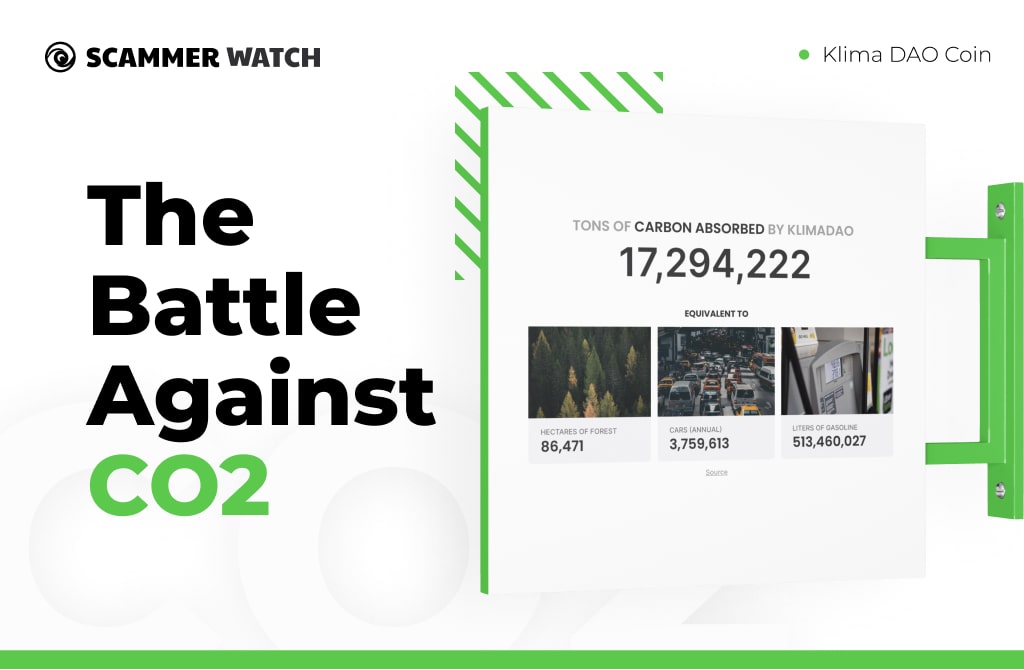
Klima DAO is part of the broader movement to reduce emissions of carbon dioxide. In simplified terms, those companies that contribute to environmental pollution (such as airlines and oil companies) can use the money obtained from selling carbon credits to finance the reduction in the overall level of pollution they’re causing.
For instance, a renewable energy plant could be built that would eliminate the need to burn extra coal and thus lower the amount of released carbon dioxide.
Blockchain-Based Carbon Offsetting
Klima DAO is intriguing because it is one of the few projects that bring the concept of carbon offsets into the world of cryptocurrency. It does this by providing a chain of tokenized carbon offsets, in the form of BCT (Base Carbon Tonne) tokens.
The advantage that blockchain technology provides over the standard means of carbon offsetting lies in its transparency. Namely, records of accounts involved in transactions and the prices paid for individual offsets are, for the first time, available for everyone to see.
Moreover, there is great dissatisfaction with the way that carbon offsetting is currently handled. The TSVCM (Taskforce for Scaling Voluntary Carbon Market), which is a private sector-led initiative seeking to optimize the voluntary carbon market, reported that less than 5% of offsets have actually contributed to the removal of carbon dioxide from the Earth’s atmosphere.
Because of this, Klima DAO’s aim is to incentivize the purchase of those carbon credits belonging to low-quality projects. The idea is to force people to buy (more expensive) offsets that might actually help to save the Earth.
In other words, the goal is to sort of lock away such cheap projects, that don’t actually contribute to improving the ecological circumstances.
Issues with Klima DAO
Unfortunately, Klima DAO, and other companies connected with blockchain-based carbon offsets, have faced serious detractors in the past months. Gold Standard is a major standard program for the regulation of carbon offsets projects. According to its head of the environmental markets, Hugh Salway, such blockchain projects can actually be unhelpful.
It seems that plenty of companies involved in blockchain-based carbon offset don’t actually need the financing they’ve acquired in this way. An extremely important concept of carbon offsetting is called additionality. It basically means that the credit is only worth it if the company could not have financed the carbon-reducing activities without outside financial assistance, which is otherwise wasted.
Many BCT tokens are linked to renewable energy projects that are more than a decade old. According to Barbara Haya, a research fellow at Berkeley, when a project doesn’t issue credits for years, there’s a very real chance of the project not really needing the offsets.
To name an example, Dayingjiang-3 is a hydropower dam in China that has converted more than 2 million credits into BCT tokens since last December. Given that Dayingjiang-3 is an existing dam that has been in function since 2006, does it actually need this kind of financial assistance? Not really.
In fact, Grayson Badgley of the major public benefit organization CarbonPlan, has stated that most blockchain-based carbon offset projects wouldn’t be eligible for trading on commodities exchanges and carbon markets that offer carbon offset contracts. The reason is that those projects started before 2016.
Klima DAO Objects… But with Little Success
Klima DAO’s response to criticism doesn’t make us particularly optimistic as to the future applications of the project. Namely, the company’s representative Natacha Rousseau admits that there is a definitive problem with the supply side of things, as one of the key concerns related to carbon credits historically has been associated with the quality of the originating projects.
On the other hand, Rousseau claims that Klima DAO’s job is, in fact, to scale up the voluntary carbon market. She cites the estimate of the aforementioned body TSVCM (Taskforce for Scaling Voluntary Carbon Market), which predicts that the volume of the voluntary carbon market will need to grow as much as 15 times, by 2030.
Rousseau states that Klima DAO’s mission is to empower everyday people, who are incentivized to buy low-quality credits and earn BCT tokens. However, that doesn’t really address the ongoing issue of money from Klima DAO’s blockchain going to inadequate creditors.
In fact, it seems that such projects are now drawn to blockchain-based carbon offsetting because it allows them to sell cheap credits. According to CryptoPlan’s analysis, many developers who haven’t issued credits in years have suddenly reappeared and started to sell again. This has shown that the plan to buy off all such cheap credits is deeply flawed, as it has lead to more cheap credits appearing than there were before.
In brief, it seems that Klima DAO is yet to provide any tangible positive effects on the level of environmental pollution.
What is Klima Crypto?
So far, we’ve discussed Klima DAO’s usefulness (or lack of it) in terms of ecological impact. But what about the profit that an average crypto user can reap? Well, in this sense, Klima DAO is certainly legit.
Once a carbon credit is turned into a BCT token, the buyer can use it to offset a tonne of carbon dioxide (1 Base Carbon Tonne token = 1 tonne of carbon dioxide reduced from the atmosphere; in theory, at least).
But, the buyer can also turn BTC tokens into KlimaDAO’s “carbon-backed currency”, simply named KLIMA. Given that cheap credits can be bought for less than $2 each, and that the current value of KLIMA amounts to $3.63 according to CoinGecko, the opportunity for profit is obvious. Just 30 days ago, KLIMA’s value was over $7, meaning that users were able to make an even larger profit until recently.
Risk note: The high APY staking mechanism that characterized Klima DAO in its 2021-2022 launch period was partly responsible for the dramatic price decline that followed. High APY staking in rebase token protocols is dilutive by design — new tokens are continuously minted for stakers, which requires continuous new demand to maintain price. When new demand slows, the inflation from staking rewards creates significant downward price pressure. Verify current staking APY and supply dynamics before any interaction.
Current Trading Availability
KLIMA trades on SushiSwap on Polygon. Verify current liquidity depth before trading. Current price is approximately $0.038 with 24-hour volume of $81.92 — very low liquidity indicating significant exit difficulty for large positions. Always verify the contract address at klimadao.finance before swapping. ScammerWatch does not recommend purchasing KLIMA or any token. This is not investment advice.
Verification Summary
Klima DAO is a publicly documented DeFi protocol on Polygon. It is not an anonymous operation. Its treasury, governance, and contract are verifiable on-chain. The project has faced significant criticism regarding the real-world effectiveness of blockchain-based carbon offsets — documented above — and its token has declined over 99% from its all-time high.
The open questions above should be verified directly at klimadao.finance before any financial interaction. ScammerWatch does not provide investment advice. If you have encountered a platform impersonating Klima DAO or using its name fraudulently, submit a report at scammerwatch.com/report-a-scam .
Author


